
Science, Technology, and Society LET REVIEWER
General Education
Lesson 13: Skeletal System
(Human Systems)

What is the Skeletal System?
The skeletal system is a complex framework of bones,
cartilage, ligaments, and tendons that provides structure and support for your
entire body. The skeletal system is the structural foundation that gives your
body shape and allows movement. It protects your vital organs, produces blood
cells, and stores important minerals like calcium and phosphorus. Without the
skeletal system, your body would collapse into a shapeless mass.
Your body's framework of bones that holds you up,
protects your organs, and makes movement possible.
Main Functions of the Skeletal System
- Protects
and supports body parts
- Enables
movement
- Produces
blood cells in bone marrow
- Stores
calcium and phosphorus
- Stores
fat for energy
Adult VS Infant Skeleton
 |
| Image from nemfrog |
Adult Human Skeleton:
- 206
bones in an
adult human
- About 360
joints where bones connect
- Hundreds
of muscles attached to bones
- Cartilage at the ends of bones
- Ligaments connecting bones to bones
- Tendons connecting muscles to
bones
Infant Skeleton:
- Babies
are born with about 270 bones
- Many
of these are made of soft cartilage
- As
the baby grows, cartilage is replaced by hard bone through ossification
- By
adulthood, most cartilage has been replaced by bone, leaving 206
bones
An adult has 206 bones that form the skeleton, which supports the body, protects organs, and allows movement.
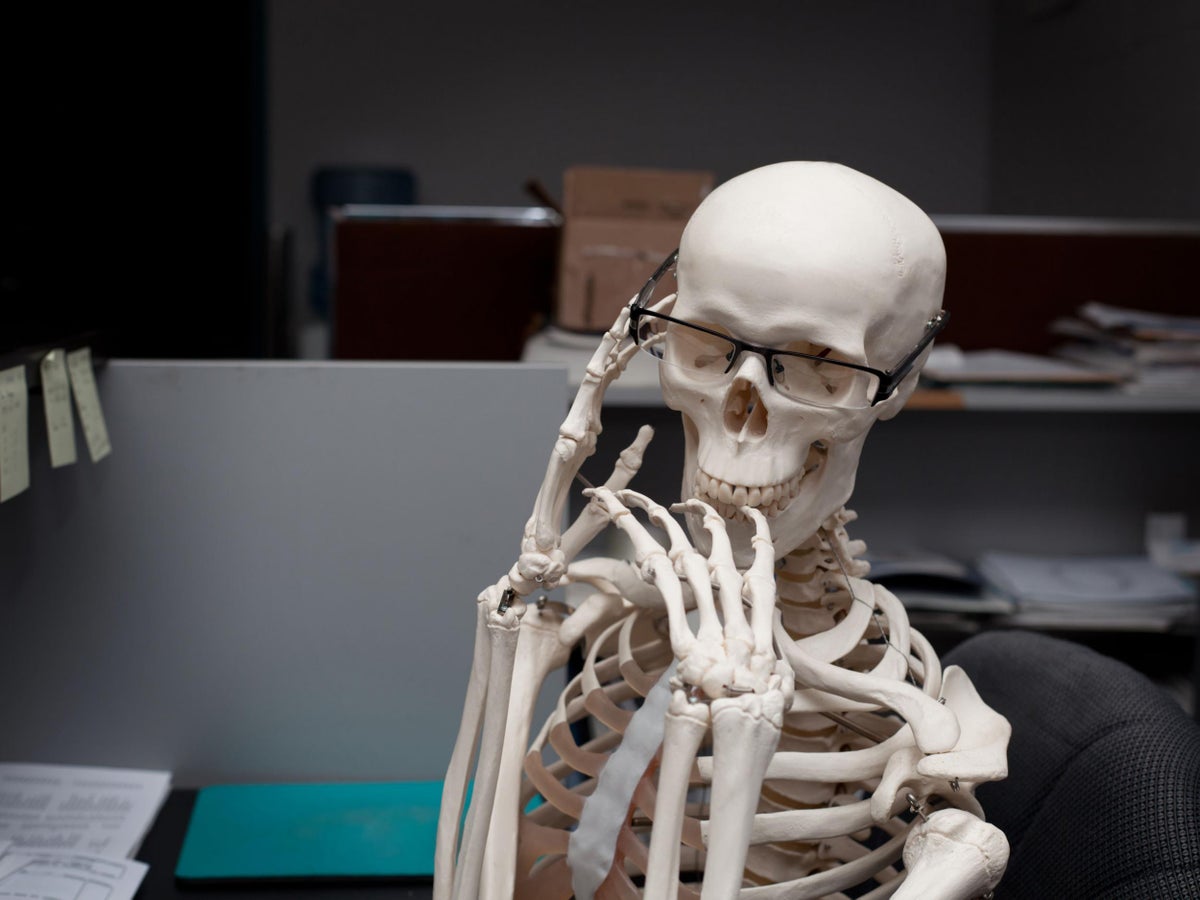
The skeletal system provides both protection and support.
 |
| Image from The Independent |
Protection
Bones form protective cages and shields for vital organs:
- Skull
- Protects
the brain
- Surrounds
and protects the eyes and ears
- Made
up of 22 bones (in adults)
- Ribcage
(Thoracic Cavity)
- 12
pairs of ribs (24
ribs total)
- Protects
the heart and lungs
- Also
protects part of the liver
- Vertebral
Column (Spine)
- 33
vertebrae (individual
bones of the spine)
- Protects
the spinal cord
- Pelvis
- Protects reproductive
organs
- Protects
intestines and bladder
Bones form protective shields around your most
important organs like your brain, heart, lungs, and spinal cord.
Support
Bones support and hold up your body:
- Vertebral
Column (Spine)
- Supports
the head, neck, and trunk
- Bears
the weight of the upper body
- Pelvis
- Supports
the vertebral column
- Transfers
weight to the legs
- Long
Bones of Legs
- Femur (thighbone), Tibia (shinbone), Fibula
- Bear
all your body weight when standing or walking
Bones act like columns and beams that support your body weight and give you shape.
The skeletal system works with muscles to create movement.
 |
| Image from Elephango |
How movement happens:
- Muscles
are attached to bones by tendons
- When
muscles contract, they pull on bones
- Bones
move at joints where they connect
Joints allow movement:
- Hinge
Joints: Move
in one direction (e.g., elbow, knee).
- Ball-and-Socket
Joints: Move
in many directions (e.g., shoulder, hip).
- Pivot
Joints: Allow
rotation (e.g., neck).
- Gliding
Joints: Allow
sliding movement (e.g., wrists, ankles).
Joints are connections between bones that allow them
to move. Muscles pull on bones at joints, creating all your body movements.
Bone marrow is a soft tissue inside bones that produces blood cells.
 |
| Image from Healthline |
What is Bone Marrow?
Bone marrow is a soft, gel-like substance found inside the hollow centers of
bones.
Two types of bone marrow:
- Red
Bone Marrow
- Produces
red blood cells (RBCs), white blood cells (WBCs), and platelets.
- Located
in flat bones (pelvis, ribs, sternum, skull) and ends of long bones.
- Produces
about 2 million red blood cells per second.
- Yellow
Bone Marrow
- Stores
fat.
- Located
in hollow centers of long bones.
- Can
convert back to red bone marrow if needed.
Red bone marrow is like a factory inside your bones
that produces new blood cells to replace old ones. Yellow bone marrow stores
fat for energy.
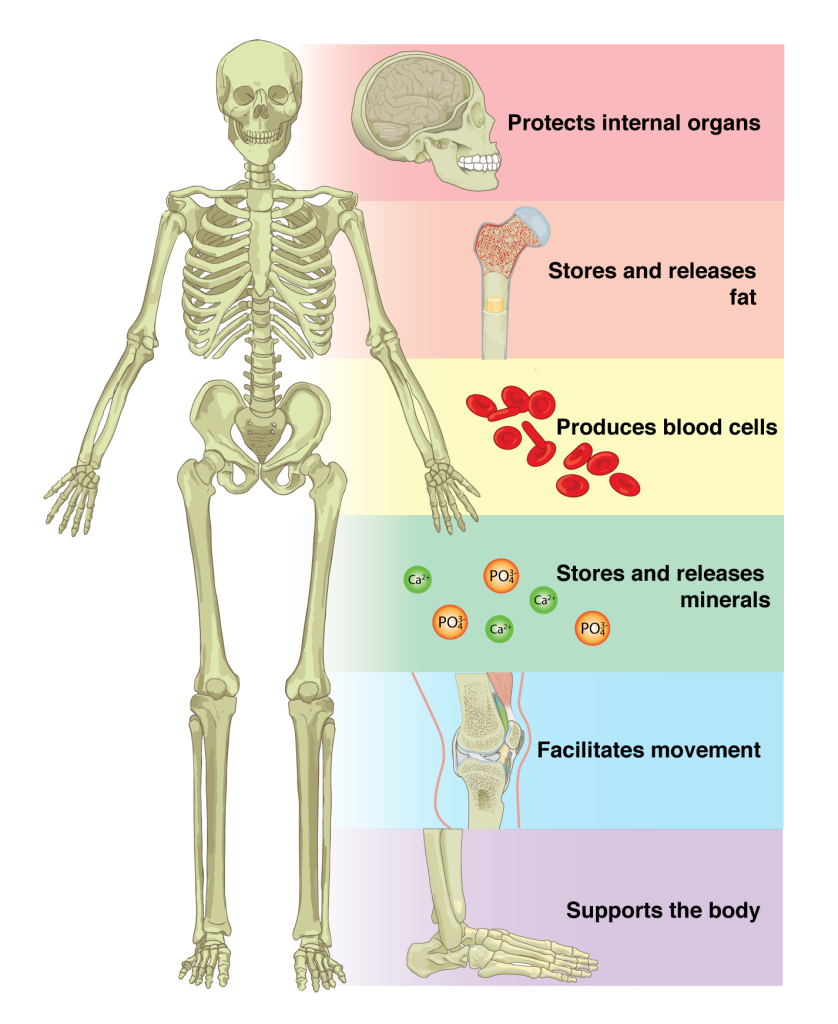
Bones serve as a storage site for essential minerals.
 |
| Image from Open library publishing platform |
Calcium Storage
- Bones
contain about 99% of the body's calcium.
- Calcium
is needed for strong bones, muscle contraction, nerve signals, blood
clotting, and heart function.
- Calcium
is released from bones when blood levels drop and absorbed when levels are
adequate.
Bones store about 99% of your body's calcium and
release it when your body needs it for muscles, nerves, and other functions.
Phosphorus Storage
- About
85% of body phosphorus is in bones and teeth.
- Phosphorus
combines with calcium to make bones hard and is part of ATP (energy), DNA,
and cell membranes.
Phosphorus works with calcium to make bones and teeth
hard and strong.
Bones have a complex internal structure that makes them strong yet lightweight.
 |
| Image from ScienceDirect |
Bone Layers (From Outside to Inside)
- Periosteum: Tough outer membrane with
blood vessels and nerves.
- Compact
Bone: Hard,
solid outer layer that provides strength.
- Cancellous
(Spongy) Bone: Porous
inner layer containing red bone marrow.
- Medullary
Cavity: Hollow
center containing yellow bone marrow.
Bones have a hard outer layer, a spongy middle layer
with spaces, and a hollow center—making them strong but not too heavy.
Types of Bones
 |
| Image from IPTA |
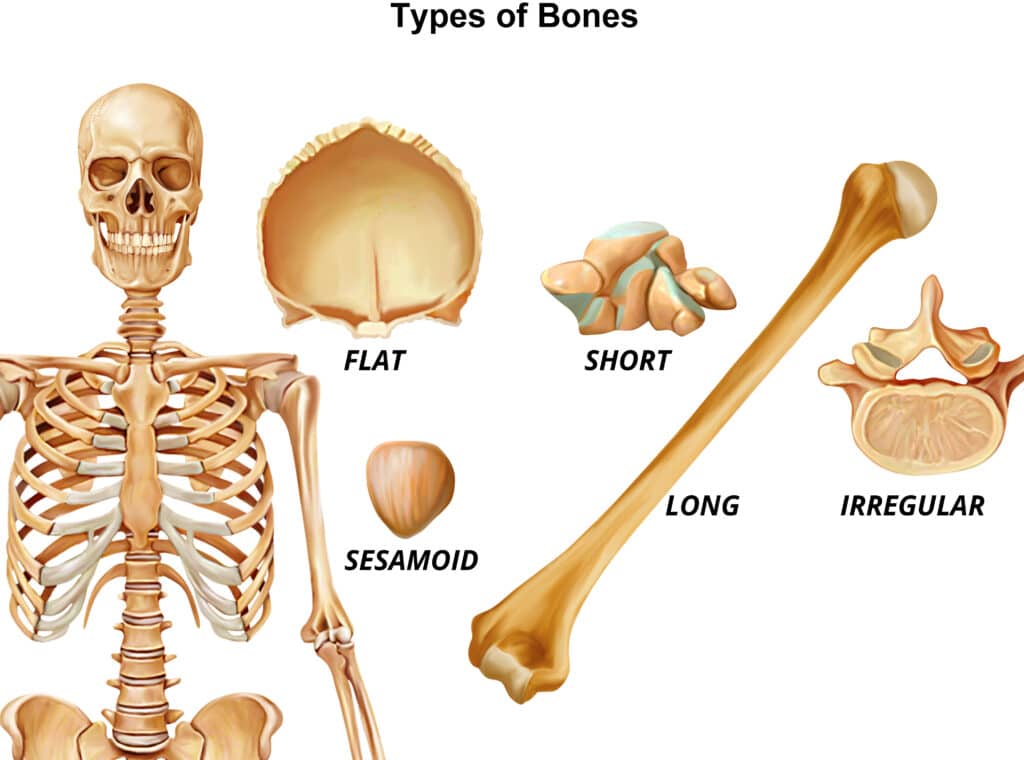
Bones are classified by their shape and function:
- Long
Bones: Longer
than wide (e.g., femur, humerus). Support weight and allow movement.
- Short
Bones: Cube-shaped
(e.g., carpals, tarsals). Provide strength and flexibility.
- Flat
Bones: Thin
and broad (e.g., skull, ribs, pelvis). Provide protection and muscle
attachment.
- Irregular
Bones: Complex
shapes (e.g., vertebrae, mandible).
- Sesamoid
Bones: Small
bones in tendons (e.g., patella/kneecap).
Bones come in different shapes, each designed for
specific functions like protection, support, or movement.
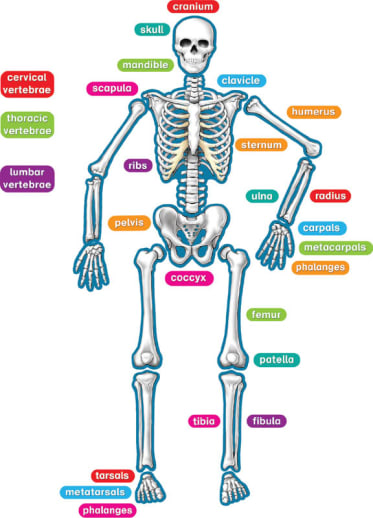
Major Bones of the Human Skeleton
 |
| Image from Rainbow Resource Center |
Skull (Cranium)
- 22
bones that
protect the brain, eyes, ears, and nose.
- Major
bones: Frontal, Parietal, Temporal, Occipital, Mandible (jaw),
Maxilla.
The skull is 22 bones that form your head and protect
your brain.
Vertebral Column (Spine)
- 33
vertebrae protecting
the spinal cord, supporting the head, and allowing
flexibility.
- Regions: Cervical (7), Thoracic (12), Lumbar (5), Sacral (5
fused), Coccygeal (4 fused).
The spine is 33 bones stacked on top of each other
that protect your spinal cord and allow you to bend and twist.
Ribcage (Thoracic Cavity)
- 12
pairs of ribs (24 total) protecting the heart and lungs.
- Attach
to thoracic vertebrae in back and sternum (breastbone) in
front.
The ribcage is 24 ribs that form a protective cage
around your heart and lungs.
Pelvis
- A
ring-shaped structure protecting reproductive organs, bladder, and
intestines.
- Bears
upper body weight; different in males vs. females.
The pelvis is a ring of bones that protects organs and
connects your spine to your legs.
Limb Bones
- Upper
Limb: Humerus (upper
arm), Radius & Ulna (forearm), Carpals (wrist), Metacarpals (hand), Phalanges (fingers).
- Lower
Limb: Femur (thigh,
longest bone), Tibia & Fibula (lower leg), Patella (kneecap), Tarsals (ankle), Metatarsals (foot), Phalanges (toes).
Your upper and lower limbs have long bones for
structure and small bones for flexibility.
Cartilage
A flexible tissue found in joints and other areas.
- Hyaline
Cartilage: Covers
ends of bones for smooth joint movement.
- Elastic
Cartilage: Found
in ears and nose for flexibility.
- Fibrocartilage: Tough shock absorber in
intervertebral discs.
Cartilage is a smooth, flexible tissue that covers
bone ends, reducing friction at joints so they can move smoothly.
Ligaments and Tendons
- Ligaments: Connect bone to bone. Provide
joint stability (e.g., ACL in knee).
- Tendons: Connect muscle to bone. Transmit
force to move bones (e.g., Achilles tendon).
Ligaments are tough cords that tie bones together at
joints. Tendons are tough cords that attach muscles to bones so muscles can
move bones.
Bone Growth and Repair
Bone Growth
- In
children, bones lengthen at the growth plate (epiphyseal plate),
where cartilage is replaced by bone.
- Growth
plates close in late teens/early 20s.
When you are young, cartilage at the ends of bones is
replaced by bone, making bones longer and stronger.
Bone Repair Stages:
- Inflammation: Blood clot forms.
- Soft
Callus: Cartilage
forms a temporary connection.
- Hard
Callus: Cartilage
is replaced by new bone.
- Remodeling: Bone is reshaped and
strengthened.
When you break a bone, your body forms cartilage to
hold it together, then gradually replaces the cartilage with new bone.
Bone Health and Osteoporosis
 |
| Image from Multiple Sclerosis Foundation |
Maintaining Healthy Bones
- Nutrition: Adequate calcium (dairy,
greens) and phosphorus (meat, nuts). Vitamin D (sunlight,
fatty fish) for calcium absorption.
- Exercise: Weight-bearing exercise (walking,
running, strength training) stimulates bone strengthening.
- Avoid: Smoking, excessive
caffeine/alcohol.
Osteoporosis
- A
condition where bones become weak and brittle due to loss
of minerals.
- Causes:
Low calcium/vitamin D, sedentary lifestyle, aging, hormonal changes.
- Prevention:
Good nutrition, regular exercise, avoiding harmful habits.
Osteoporosis is when bones lose calcium and become
weak and brittle, breaking easily.
Skeletal System Quiz: click here