
Science, Technology, and Society LET REVIEWER
General Education
Lesson 25: Continental Drift Theory

Continental Drift Theory
(Alfred Wegener)
 |
| Image from store norske leksikon |
Long ago,
the continents were not separated like they are today. Alfred Wegener, a
German scientist, proposed the Continental Drift Theory in the early
1900s. He said that all the continents were once joined together as one huge
landmass and have slowly drifted to their present positions.
 |
| Image from Geology In |
This
ancient supercontinent was called Pangaea, which means “all land.” Over
millions of years, Pangaea broke apart into pieces. These pieces slowly moved
away from each other to form the continents we see on the map today. At
Wegener’s time, scientists did not yet know exactly how the continents moved,
but he collected clues that they had once been joined.
 |
| Image from The Open University |
One key
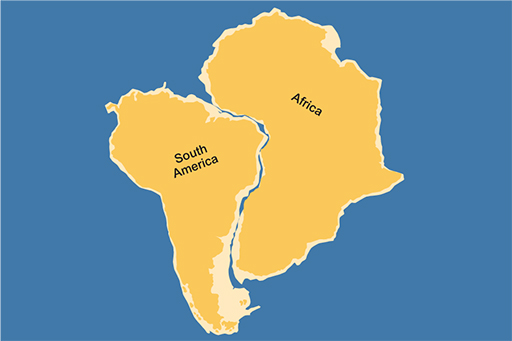
piece of evidence was the jigsaw‑like shapes of the continents. If you
look at a world map, the east coast of South America and the west
coast of Africa seem to fit together like puzzle pieces. Wegener also found
similar rocks and fossils on continents now far apart, but for this lesson, the
“puzzle fit” of South America and Africa is the most important and easy to
remember.
- Continental Drift Theory –
continents slowly move over Earth’s surface.
- Pangaea – a supercontinent,
where all continents were once joined.
- Evidence – jigsaw‑like shapes
of South America and Africa that fit together.
Wegener said that the continents were once one big land called
Pangaea and drifted apart, like puzzle pieces sliding away.
What Is an Earthquake?
An earthquake
is any sudden movement of the ground. It happens when energy that has
built up inside Earth is released very quickly. This release sends seismic
waves through the ground, which we feel as shaking. Earthquakes can be too
small to notice, or strong enough to damage buildings and roads.
 |
| Image from Caltech Science Exchange |
Most
earthquakes are related to tectonic plate movement. Earth’s outer shell
(lithosphere) is broken into pieces called tectonic plates. These plates
move slowly, but they can get stuck along cracks called faults. As
plates keep trying to move, stress builds up. When the rocks suddenly slip or
break, the stored energy is released and the ground shakes this is an
earthquake.
Earthquakes
can also be caused by volcanic activity. This is called an earthquake of
volcanic origin. In this case, the shaking is caused by magma moving
inside or beneath a volcano. As magma rises and pushes through vents and
cracks, it forces rocks to move and break, causing smaller quakes near the volcano.
- Earthquake – any movement
of the ground due to volcanic eruption or tectonic plate movement.
- Tectonic origin – caused by plates
moving and slipping along faults.
- Volcanic origin – caused by magma
moving through vents inside a volcano.
An earthquake is the ground shaking because rocks inside Earth
suddenly move, often along plate boundaries or around volcanoes.
Parts of an Earthquake:
Foreshock, Mainshock, Aftershock
Earthquakes
often happen as a sequence, not just as one single shake. We give names
to the different shakes based on when they occur and how strong they are.
 |
| Image from SCIRP |
A foreshock
is a smaller earthquake that happens before the biggest quake in the
sequence. It is like a warning shake or the “trigger” that comes first.
The mainshock is the strongest earthquake in the sequence. It
releases the largest amount of energy and usually causes the most damage. After
the mainshock, there are often more, smaller quakes called aftershocks.
Aftershocks are weaker than the mainshock and happen as the crust adjusts and
“settles” after the big movement. You can think of them as the “weaker”
follow‑up shakes.
- Foreshock – comes before the
mainshock; usually smaller; the “trigger.”
- Mainshock – the strongest
earthquake; the main event.
- Aftershock – weaker quakes that
happen after the mainshock as the crust adjusts.
First can come a small foreshock, then the big mainshock, and
then several weaker aftershocks that follow.
Focus and Epicenter
During an
earthquake, the rocks break or slip at a certain point inside Earth. This point
is called the focus (also known as the hypocenter). It is the true
point of origin of the earthquake, where the movement along a fault
actually starts.
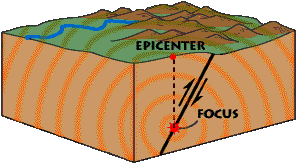 |
Image from Eco-intelligent |
The epicenter
is the point on the Earth’s surface directly above the focus. When news
reports say “the epicenter was in this city,” they mean that city lies above
the focus. The shaking is often strongest close to the epicenter because it is
nearest to where the energy came from.
- Focus – the point inside Earth
where the fault movement begins; the origin of the quake.
- Epicenter – the point directly above
the focus on the Earth’s surface.
The focus is the starting point of the earthquake inside Earth;
the epicenter is the spot on the ground right above it.
Magnitude vs. Intensity
To
describe earthquakes, scientists and people use two different ideas: magnitude
and intensity. These words do not mean the same thing.
 |
| Image from The Core Coaches |
Magnitude measures how much energy
the earthquake releases at its source. It is a single number for each
earthquake, no matter where you are. One common way to measure magnitude is the
Richter Scale, created by Charles Richter. Higher magnitude means
more energy released. For example, a magnitude 6 releases much more energy than
a magnitude 4.
Intensity, on the other hand, describes what
people feel and what damage is seen in different places.
Intensity can be different in different locations during the same earthquake.
Areas close to the epicenter usually feel stronger shaking and may have higher
intensity. A common way to describe intensity is the Mercalli Intensity
Scale, which uses descriptions like “felt by few,” “felt by many,” “some
damage,” or “heavy damage,” instead of just numbers.
- Magnitude – how much energy is
released by the earthquake.
- Measured by the Richter
Scale, developed by Charles Richter.
- One value for the whole
earthquake.
- Intensity – how strong the shaking
feels and how much damage it causes.
- Measured by the Mercalli
Intensity Scale.
- Can be different from place
to place.
Magnitude is the earthquake’s energy; intensity is what people
feel and the damage they see.
Continental Drift Theory Quiz
