
Science, Technology, and Society LET REVIEWER
General Education
Lesson 23: Geological Time Scale

The Geologic Time Scale (Big Picture)
 |
| Image from Geology In |
Scientists divide Earth’s 4.6‑billion‑year history
into big blocks of time so it is easier to study. The main divisions are:
- Eon – the largest unit
(hundreds of millions to billions of years).
- Era – a big block within an eon
(many tens or hundreds of millions of years).
- Period – a subdivision of an era.
- Epoch – a smaller slice inside a
period.
The Mesozoic Era (often called the “middle
life” or “medieval” era of Earth) is one of the eras in the Phanerozoic Eon.
Within the Mesozoic, there are three main periods: Triassic, Jurassic,
and Cretaceous.
 |
| Image from Shutterstock |
- The Triassic
Period comes first.
- The Jurassic
Period comes next.
- The Cretaceous Period comes after the Jurassic and ends the Mesozoic.
The Mesozoic Era: “Middle Life”
 |
| Image from Medium |
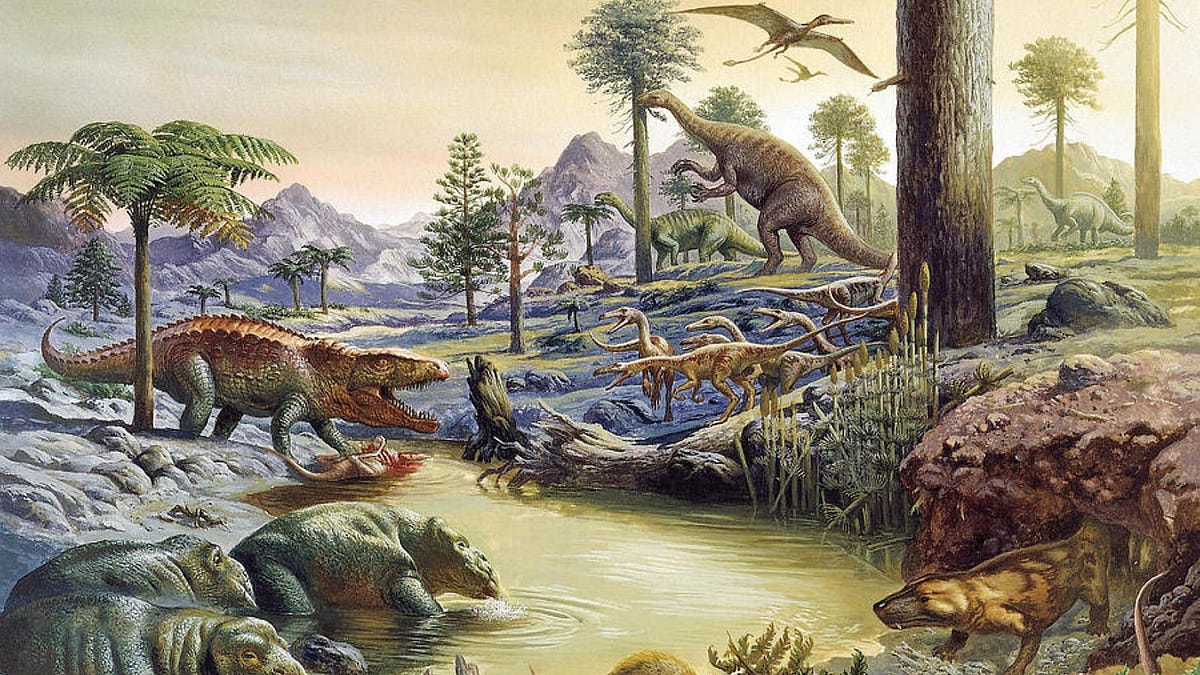
The Mesozoic Era is often called the Age of Dinosaurs
because dinosaurs became very important and dominant on land during this time.
At the beginning of the Mesozoic, most of Earth’s land was joined together in
one huge supercontinent called Pangaea. Over millions of years, Pangaea
slowly broke apart, and the continents began to move toward the positions they
have today. While the continents moved and the climate changed, new groups of
animals and plants evolved and spread.
- Name: Mesozoic means “middle
life”.
- Location
in time:
Comes after the Paleozoic Era and before the Cenozoic Era.
- Famous
for:
Dinosaurs on land, early mammals, early birds, and changing continents.
The Mesozoic was the “middle” era of visible life,
when dinosaurs ruled and Earth’s continents began to split apart.
Triassic Period (about 201.3 - 251.9 million years ago)
 |
| Image from Design Bundles |
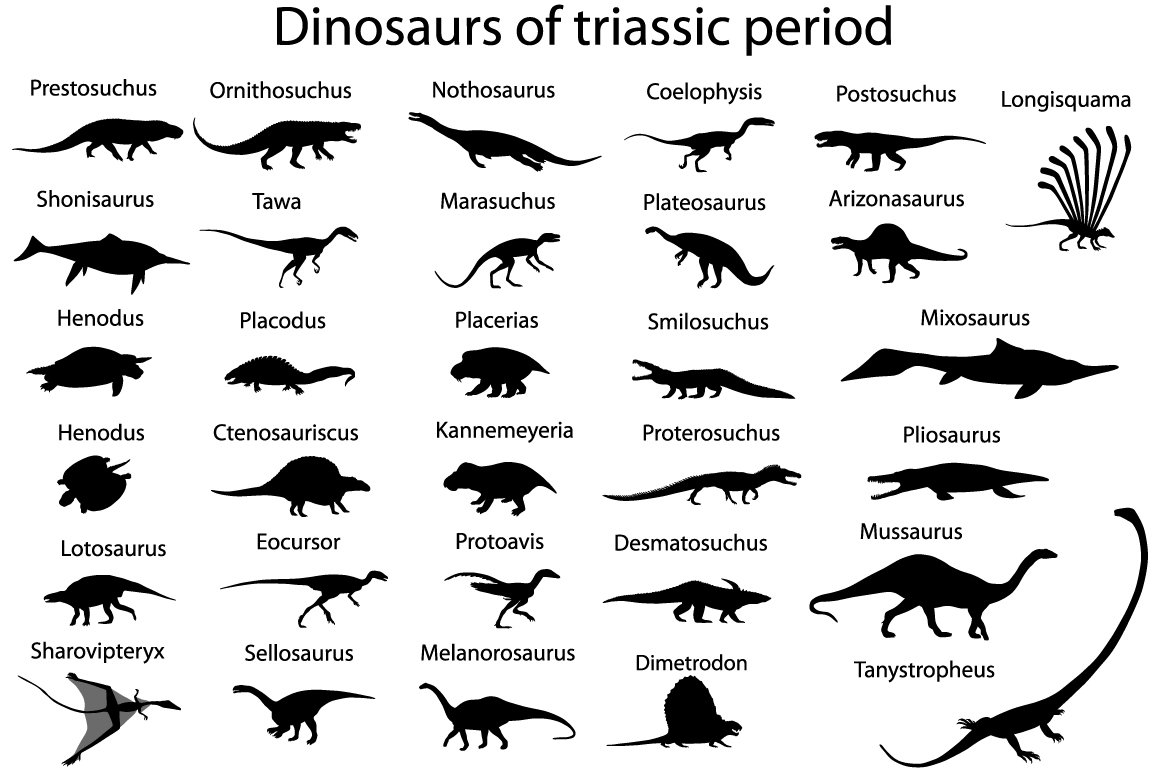
The Triassic Period is the first period
in the Mesozoic Era. In your time range, it is listed as about 201.3 - 251.9 million years ago (m.y.a.). It began after a huge mass extinction at the
end of the Paleozoic, when many kinds of life disappeared. During the Triassic,
life slowly recovered and new groups of animals appeared. The climate was
generally warm and dry in many places, especially in the middle of Pangaea, which
had large desert areas.
One of the most important events in the Triassic
was the appearance of the first dinosaurs and the first mammals. At
first, dinosaurs were not yet the biggest or most powerful animals; they were
just one group among many reptiles. Early mammals were very small, likely
nocturnal (active at night), and looked a bit like tiny shrew‑like creatures.
They did not dominate, but they had already started to evolve during this time.
- 201.3 - 251.9 m.y.a.
- Key
events:
- First
dinosaurs appear.
- First mammals appear.
- Environment: Often hot and dry,
with many deserts on the supercontinent Pangaea.
The Triassic is when dinosaurs and mammals first
appeared, starting quietly as small, new groups in a warming world.
Jurassic Period (about 201.3–145 million years ago)
 |
| Image from Sleepless |
The Jurassic Period is the second period
of the Mesozoic, following the Triassic. During the Jurassic, dinosaurs became much more successful and
widespread. The climate was generally warm and more humid than in the Triassic,
and large forests and lush plant life covered many areas. With plenty of
plants, there was enough food to support huge plant‑eating dinosaurs, and this
allowed many kinds of large predators to evolve as well.
Because dinosaurs were so abundant and diverse on
land, the Jurassic Period is often called the “Age of Dinosaurs.” Giant
long‑necked dinosaurs (sauropods), large meat‑eaters, and many other groups
evolved and spread. At the same time, the first true birds evolved from
small, feathered theropod dinosaurs. Feathers probably first developed in some
dinosaurs for insulation (keeping warm) or display, and later helped in gliding
and flight. This is why we can say that dinosaurs had feathers especially
some small meat‑eating kinds and why many scientists consider birds to be
living dinosaurs.
- 201.3–145 m.y.a.
- Nickname: Age of Dinosaurs
(dinosaurs become dominant on land).
- Important
points:
- Dinosaurs
grow larger and more varied.
- Early
birds evolve from feathered dinosaurs.
- Feathers appear in some dinosaur
groups, not just in birds.
The Jurassic Period is the time when dinosaurs
truly dominated the land and some of them developed feathers, leading to the
first birds.
Triassic and Jurassic in the Geologic Time Scale
| Image from Course Hero |
On the geologic time scale, both the
Triassic and Jurassic are periods inside the Mesozoic Era, which
is inside the Phanerozoic Eon. The order from larger to smaller is:
- Eon → Era → Period
→ Epoch
For this lesson focusing on the Mesozoic Era:
- Eon: Phanerozoic
- Era: Mesozoic (middle life)
- Triassic
Period
(201.3 - 251.9 m.y.a.): first dinosaurs and mammals appear.
- Jurassic Period (201.3–145 m.y.a.): Age of Dinosaurs; dinosaurs become dominant and some have feathers.
Triassic comes first with the first dinosaurs
and mammals, and Jurassic comes next as the Age of Dinosaurs, with
feathered dinosaurs and early birds.
Geological Time Scale Quiz

We are focusing only on the Triassic and Jurassic periods, since these appear most frequently in General Education, specifically in Science.
ReplyDelete